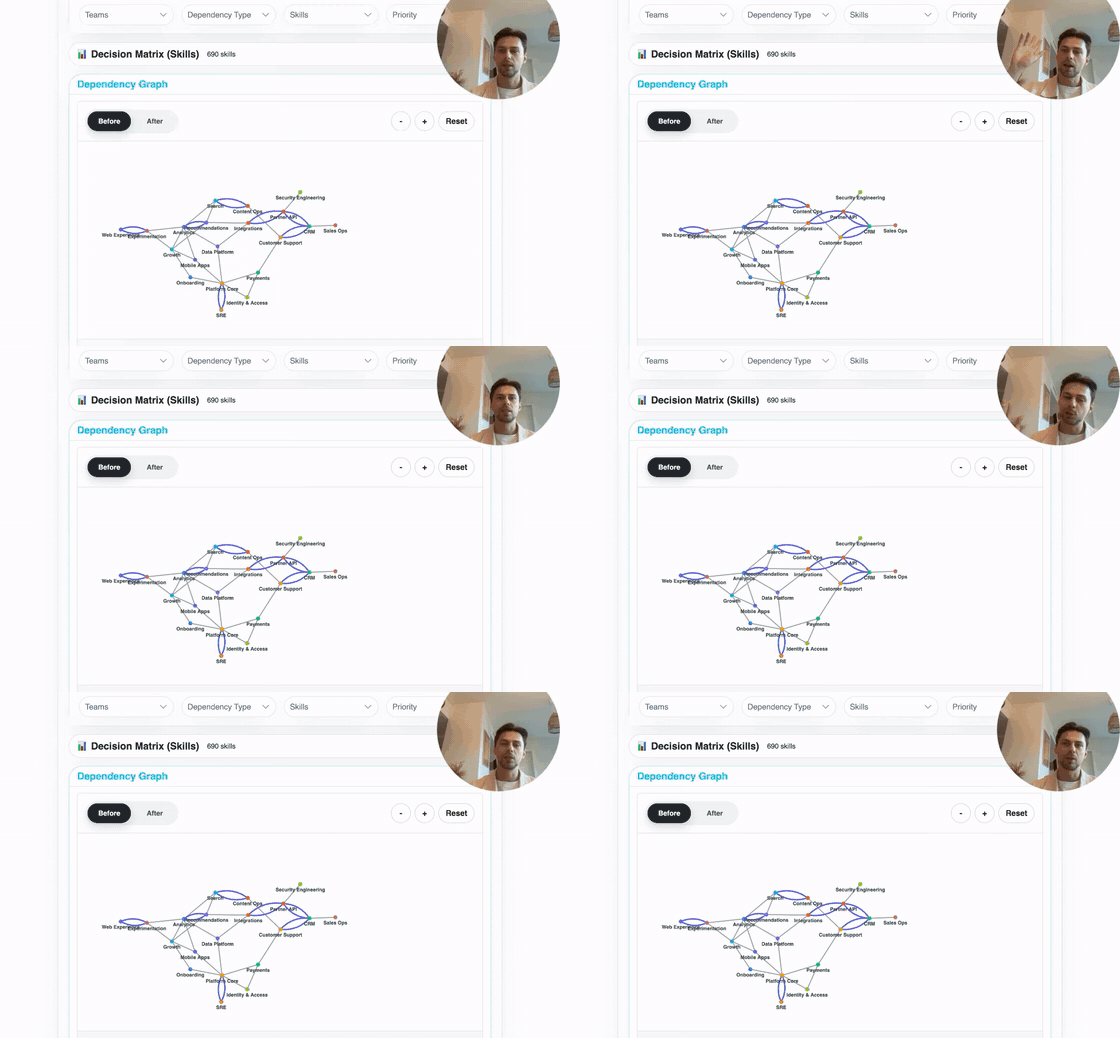
AgileHR helps show where work gets stuck across teams and where delays begin.
See where your delivery slows down
Book a free 30-minute session to identify your key constraint and the next step.
AgileHR helps engineering leaders spot coordination bottlenecks, fragile skills dependencies, and ownership risks across teams, so the next org decision feels clearer, safer, and easier to explain.
Get a first view of which dependencies, handoffs, or skills are most likely slowing delivery right now.
Start with one real bottleneck. Leave with a clearer view of what is slowing work down and what the first useful step should be.
Book a free 30-minute session to identify your key constraint and the next step.
“We know something is slowing us down, but we still cannot say clearly what is actually creating drag across teams.”
What this helps you do: See which dependencies, handoffs, or skill concentrations are most likely slowing delivery right now.
“We could hire, reorganize, or redistribute ownership, but it is hard to know which move is actually justified.”
What this helps you do: Make the next org decision with more confidence, less guesswork, and less risk of changing the wrong thing.
“On paper, ownership looks clear. In practice, work still waits between teams or relies too heavily on a few critical skills.”
What this helps you do: See where teams can safely take more ownership and where hidden dependencies still make that risky.
Sequential dependencies are usually easier to coordinate. Reciprocal dependencies create more waiting, rework, and alignment overhead.
Simple, one-way flow keeps coordination low.
Fewer touchpoints, faster throughput.
Ongoing back-and-forth drives coordination up.
More waiting, rework, and alignment overhead.
AgileHR is built to find the dependencies that cost you the most.
Our algorithm ranks team dependencies by coordination cost, so you can see where delivery is really slowing down and where the first useful change should start.
Interactive dependency sample
Most leaders already know delivery feels slower than it should. What they usually need next is a clearer view of where coordination drag, fragile skills, and ownership gaps are actually compounding.
Case recommendations
Open the live demo to see how handoffs, bottlenecks, and ownership gaps show up in a real team view.
See live demoYou need a clearer view of dependencies and skills before hiring around the wrong problem.
You can move responsibilities on paper, but if dependencies stay the same, coordination overhead will keep slowing delivery.
Some parts of the system may be ready for more ownership. Others may still depend too heavily on critical skills or repeated handoffs.
You need to separate symptoms from the underlying structural pattern.
You want to move from “this feels right” to a clearer, more evidence-based explanation of what should change first.
Click a stage and the detail panel updates without changing the page context.
Teams answer a short questionnaire about skills, dependencies, and criticality. You can also start with your own view if needed.
Capture team signals on dependencies, skills, and waiting points in one lightweight pass.
Turn local responses into one map of cross-team handoffs, ownership boundaries, and critical skills.
Expose the bottleneck pattern that actually slows delivery instead of chasing surface symptoms.
Compare options: handoff redesign, capability transfer, ownership shift, or structural intervention.
Iterate as teams evolve so decisions stay grounded in current constraints, not outdated assumptions.
Many tools show activity inside teams. Fewer help leaders understand what happens between teams. AgileHR focuses on cross-team handoffs, critical skills, ownership boundaries, fragile skill concentrations, and recurring coordination load.
Sometimes teams are reorganized, but the underlying handoffs, ownership gaps, and critical skills remain the same. The org chart changes. The friction does not.
Sometimes the issue is not lack of people. It is repeated coordination, fragile critical-skill dependencies, or a handoff pattern that keeps creating delay.
A consultant can give you an answer. But the answer is expensive, time-bound, and rarely repeatable. With AgileHR, you get methodology, tools, and access to experts in a form the organization can keep using over time.
For small teams getting started
10 usersBest for: A clear first view of what skills exist in the team and where capability gaps may be emerging.
For teams that need to improve how work flows across the system
Everything in Free, plus:
Best for: Leaders who want to see where work gets stuck, which dependencies create drag, and what the right next change should be.
No. You do not need a perfect map of the organization to begin. AgileHR starts with lightweight input from teams, or even with your current leadership hypothesis. The goal is to surface the first real constraint: where work waits, where ownership is unclear, or where a critical skill dependency is creating delivery risk.
The diagnostic is only useful if it leads to a better decision. AgileHR connects the picture to practical signals: repeated handoffs, rework, critical skills, ownership gaps, coordination drag, and delivery risk. The output should help you decide whether to clarify a handoff, transfer a capability, adjust ownership, or define a safer first scope.
AgileHR is designed around data minimization. Scope, access, and usage are defined upfront, and the focus is on dependencies, skills, ownership boundaries, and flow risks rather than unnecessary personal data. Sensitive information should be handled under GDPR-oriented practices.
No. The landing's core point is the opposite: start with one real bottleneck, not a company-wide redesign. AgileHR helps you see whether a small change is enough, or whether a larger structural change is actually justified.
Yes, if those teams already share critical skills, hand work across boundaries, or depend on each other to ship. AgileHR can also diagnose bottlenecks inside a single team: unclear ownership, overloaded critical skills, missing skills, repeated waiting, or handoffs between roles. A smaller scope can be a strong starting point because the first patterns are easier to validate before expanding.
Those tools can show useful activity and delivery signals, often inside teams. AgileHR focuses on what happens between and inside teams: handoffs, critical skills, ownership gaps, fragile skill concentration, and recurring coordination load. Unlike long metric-collection cycles, the first relevant input can come from a 30-minute bottleneck review.
You should leave with a simple first answer: where work is probably getting stuck, why it may be happening, and what is worth checking next. The review helps you turn a vague feeling like "delivery is slower than it should be" into a practical next step, without committing to a big transformation program.
AgileHR is meant to become an evolving operating view, not a one-off report. You get a first view of your bottlenecks, validate the strongest hypothesis, take the next useful step, and then move to the next bottleneck as the organization changes. Over time, this builds a shared picture of dependencies, critical skills, ownership boundaries, and recurring coordination risks.
AgileHR starts narrow, looks for patterns across inputs, and treats the first output as a hypothesis to validate rather than a perfect truth. The safest first step is to identify what looks reliable, what needs more context, and which recommendation is small enough to test.
Book a 30-minute bottleneck review. Leave with a clearer view of:
Start with one real bottleneck, not a company-wide redesign.